


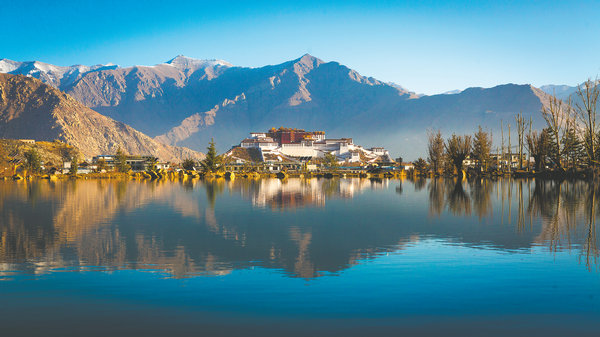
Over the past few months, the tires of Ulianova Vlada's vehicle have tracked more than 35,000 kilometers across the roof of the world.
The Russian founder of AvanLu travel agency has called China home for over 11 years. To see more of the country, she decided to embark on an expedition deep into the heart of the Xizang autonomous region in southwestern China.
This was not just a journey but a mission of discovery.
"I chose this path because I needed to go and 'deconstruct' the routes from a foreigner's perspective," Vlada explains.
"Only then could I truly understand which places are suitable for international visitors."
The drive took her through much of the Tibetan cultural region, from the plateau's rugged eastern escarpment to its remote, high-altitude interior. She even undertook the challenging pilgrimage circuit around the sacred Mount Gang Rinpoche.
"I completed the circumambulation last year, and returned this November to walk the route again, filming and preparing to introduce it to my clients," she says.
Vlada believes the autonomous region holds great appeal for her fellow Russians.
"It is a place of profound depth, both culturally and spiritually," she observes.
"Many Russians are drawn to paths of practice — they enjoy meditation and love pristine nature. Xizang is perfectly suited for this."
Kelsang Phuntsok, director of the exchange and cooperation division with the Xizang culture and tourism department, felt a growing international interest in the autonomous region at the China International Travel Mart, which concluded in Haikou, Hainan province, in late December.
"We have tangibly sensed the interest of overseas partners in what Xizang has to offer," he notes.
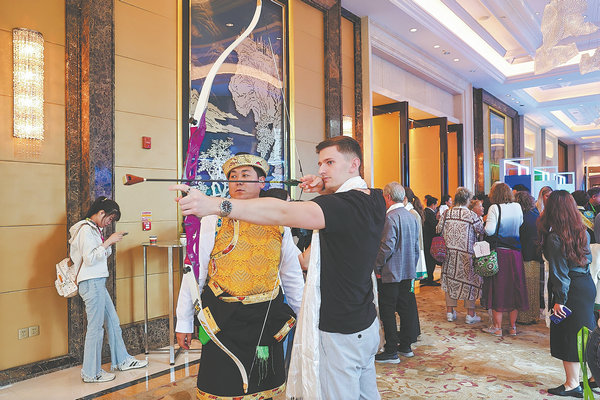
This surge in global curiosity was vividly displayed at the travel mart, where Xizang showcased its living cultural heritage.
"We brought various intangible cultural heritage items from Xizang for on-site production and display," Kelsang Phuntsok says, noting that many inbound tour operators actively engaged in the cultural activities.
"During negotiation sessions, many of our travel agencies reached cooperation agreements with overseas counterparts," he adds.
Kelsang Phuntsok believes the foundation of this growing appeal lies in Xizang's unique, blended offerings.
"Xizang's core strength is not merely its singular natural landscape or Tibetan culture, but the deeply integrated experience formed by a fusion of extraordinary natural scenery and unique cultural heritage," he says.
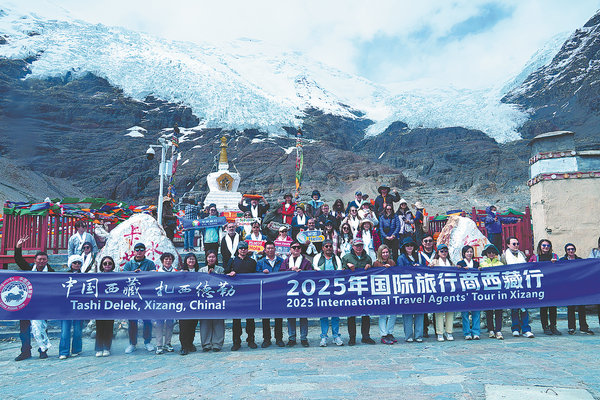
In recent years, local authorities have organized tours for international travel agents to experience the unique cultural depth and rich tourism products, which have yielded positive feedback and led to numerous collaborations, Kelsang Phuntsok explains.

Additionally, the autonomous region has consistently participated in numerous large-scale cultural exchange activities and international tourism exhibitions to exhibit its rich tourism offerings.
To better accommodate international travelers, Xizang has continuously strengthened the training of multilingual tour guides, improved hotel and service facilities' international standards, and perfected multilingual signage systems across the region.
International travelers' growing interest in Xizang is particularly evident in specific destinations like Shigatse.
Nestled in the heart of the Himalaya Mountains, the city in the southwest of Xizang has been experiencing a remarkable surge in international visitors.
"The number of inbound tourists to Shigatse has shown a clear upward trend," says Shen Ke, deputy director of the Shigatse culture and tourism bureau.
From January to November, Shigatse welcomed over 125,000 international visitors, a staggering 193 percent year-on-year increase, the bureau reports.
Inbound travelers are mostly from Europe and America, and neighboring South Asian countries like Nepal.
For most, Qomolangma (Mount Everest) remains the ultimate attraction, but Shen adds that many also explore the allure of Shigatse's city itself, especially the historic Tashi Lhunpo Monastery for its sacred halls and natural getaways, and Dochen Tso lake and hot springs.
"This blend of culture and landscapes has been increasingly appealing to international audiences," Shen says.
To harness this momentum, local authorities have introduced innovative incentives, including the Qomolangma tourism ambassador award, which rewards visitors for exploring multiple scenic spots.
Shigatse is also enhancing the visitor experience to meet global standards.
"We are working to improve support services," Shen explains, citing regular guide training, upgraded hotels, and oxygen supplies at key sites.
Travel products are also evolving from sightseeing to immersion, with tours that include visits to local homes for butter tea and traditional dancing, he emphasizes.
"It enhances the visitor experience and fosters cultural exchange," he adds.
Tibetan guide Li Damchue Tsering, who has led international tours across Xizang for decades, sees his international clients seeking a far deeper, more experiential journey than before.
"Many foreign tourists now spend one to two years researching before coming to Xizang," he observes, adding that their itineraries are no longer a simple checklist of major sites but are purposefully crafted around specific cultural interests.
For instance, he arranged for groups of German and other European guests to visit off-the-beaten-path cultural gems, such as an ancient monastery dating back to the Song Dynasty (960-1279) in Chamdo, eastern Xizang.
"They were fascinated by the revered Tibetan calligraphy and precious artifacts from the Ming (1368-1644) and Qing (1644-1911) dynasties," Li says.
The mode of engagement is also evolving from passive observation to active participation.
"Foreign visitors are eager for hands-on cultural immersion, and they often try their hand at crafting Tibetan incense or painting a thangka," he observes.
At the Min Zhu Lin Tibetan incense workshop in Lhokha, inheritor Damchoe Tenzin has witnessed a steady stream of international visitors seeking an authentic taste of ancient crafting since 2015.
"Most visitors come from Australia, the United States, and Europe," says Damchoe Tenzin, in his 50s.
They arrive at his workshop for a 30-minute immersion into the world of traditional Tibetan incense.
"They look at the raw materials and watch the process," he explains, adding that he guides them through ingredients like premium saffron, eaglewood and white sandalwood.
Visitors are particularly fascinated by the blending stage, often requesting to make themselves a milder-scented variant, he says.
The rising tourism business has also brought positive financial impacts, with the facility's annual income reaching more than 7 million yuan ($996,587) annually, Damchoe Tenzin states, which benefits him and his fellow practitioners.
While group travel remains the primary mode for foreign visitors, Li affirms the process is more streamlined. Working with licensed travel agencies that handle travel permits allows for better-tailored itineraries and guaranteed services, including translation, he points out.
Armed with her on-the-ground insights, Vlada is now crafting tailored Xizang-focused itineraries for her guests.
At the top of the list is the Gang Rinpoche pilgrimage tour, which she believes will be a major draw for the Russian market.
"Many Russians know of the mountain, and wish to do the circumambulation," she says.
Beyond that, she is designing comprehensive routes spanning Lhasa, Nyingchi, and Lhokha, and is planning an expedition along the remote northern Ngari route, which she believes holds exceptional beauty.
Trip durations will range from a 7-day cultural introduction to extended journeys incorporating the pilgrimage.
A significant tailwind for her venture is China's visa-free policy for Russian citizens, which was implemented in September 2025.
"This is very important. Now, they can easily come to us and enter Xizang after we handle the permit," Vlada says.
"We're already receiving many inquiries about how to travel to Xizang."
Her extensive survey has left her deeply impressed with the region's tourism infrastructure, which she sees as a key advantage.
"The roads are good, and there are cafes and restaurants around each site; everything you need," she shares.
"Plus, the driving was comfortable and convenient, and the people were friendly. It is positive proof of well-developed tourism areas."
Contact the writer at yangfeiyue@chinadaily.com.cn





