

China's steady opening-up for Asia-Pacific economic growth









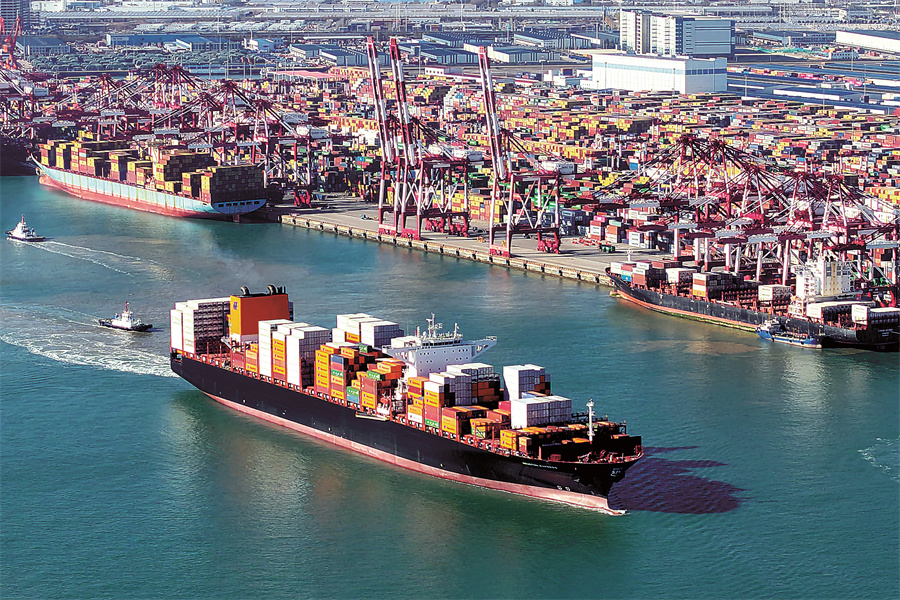
Global trade enters 2026 after a tumultuous year marked by the United States tariffs. Never before had free trade been so heavily jeopardized, as countries experienced frenzies of disarray with escalating tariffs imposed generally on goods and, specifically, on critical commodities and products.
The global trade setting is tending toward a "world-minus-one" regime where the minus is ironically the world's largest economy — the US. As a significant economic superpower, the US is expected to be a responsible promulgator of development worldwide — yet its trade actions have completely eroded its moral leadership mandate. Countries affected by the tariffs will have to move on in their quest for growth and seek their destinies among themselves.
By default or even more by design, China, as the world's second-largest economy, will be well placed to provide continuity to countries, especially those in the Asia-Pacific region, in their economic pursuits.
The new year will be the first year of China's 15th Five-Year Plan. A key anchor of this strategic blueprint is the theme of high-standard opening-up which encompasses the promoting of international economic flows as well as the safeguarding of the multilateral trading system.
The opening-up narrative will involve three core aspects: developing new trade-based zones, coordinating with regional trade-focused agreements and enhancing trade-related regulatory reforms.
The most novel development is the transformation of Hainan province into a full free trade port with a special and separate customs system. This initiative provides a complete opening of the first line, where there is total free flow within the island, while a second line continues the present policy for access into the mainland markets.
The Hainan Free Trade Port will be the country's most liberal experiment in trade, investment and economic governance. It will be characterized by liberalization, regulatory streamlining and business environment upgrades.
Hainan's free trade port aspires to be a world-class business and tourism hub that is linked to the Belt and Road Initiative, particularly the Maritime Silk Road. It positions the island as a gateway for China's integration with Asia-Pacific economies, especially the ASEAN countries.
Hainan's new development complements China's existing network of over 20 free trade zones throughout the country. While each of these zones has specific sectoral or geographical focuses, Hainan's model is an even bolder and broader platform that will bring bigger and better benefits to overseas partners.
China has been actively working toward joining the Comprehensive and Progressive Agreement for Trans-Pacific Partnership and the Digital Economy Partnership Agreement. For China, these initiatives will foster an expanding network of high-standard free trade areas and provide key pathways for market opening-up, especially in the coming five years.
The CPTPP will hasten the reduction of tariffs for an even higher share of trade with partners, thus providing cheaper access to goods for all. Even more importantly, the partnership provides a rules-based multilateral trading system which is inclusive and predictable.
DEPA is a unique alliance of Asia-Pacific countries committed to easing cross-border data flows together with trusted safeguards, interoperable privacy and security standards. It moves data-localization mandates toward free-flow mechanisms, thus enabling even higher levels of mutually beneficial trade to occur.
China's participation in CPTPP and DEPA will be a win-win for trading partners in the Asia-Pacific region and beyond.
In parallel with the opening-up, various regulatory reforms will be in place to augment global involvement in China's trade and investment.
The intellectual property rights regime is being strengthened to support high-quality innovation development by overseas players. This will encompass the key aspects of protection, enforcement and recourse for patents, trademarks and copyrights. Definitions, rules and procedures will be further clarified.
In accordance with free trade requirements, the competition environment in China will be reinforced so that international businesses can rapidly access and gain by entering the Chinese commercial arenas.
In essence, the triple impetuses will collectively benefit China's trading partners. They create the foundational conditions for a trade setting that is free from tariffs and other hindrances. Free trade brings value that will enable national economies to grow — only with growth can we create livelihoods which will, in turn, lead to better lives for all.
China's opening-up drive, on the back of the new five-year plan, goes beyond pure rhetoric. It represents a real commitment of "putting the money where the mouth is". It is a mark of responsibility that is most needed amid global uncertainties.
Indeed, more than just filling up the void in the "world-minus-one" regime, China's continuing opening-up will anchor an unprecedented Asia-Pacific trade order that can be a model for the world.
The author is director of the Centre for Governance and Sustainability and executive director of the Wellbeing and EESG Alliance (WEGA) at NUS Business School of the National University of Singapore.
The views don't necessarily reflect those of China Daily.
If you have a specific expertise, or would like to share your thought about our stories, then send us your writings at opinion@chinadaily.com.cn, and comment@chinadaily.com.cn.