

Japan's nuclear ambitions call for high alert: China Daily editorial









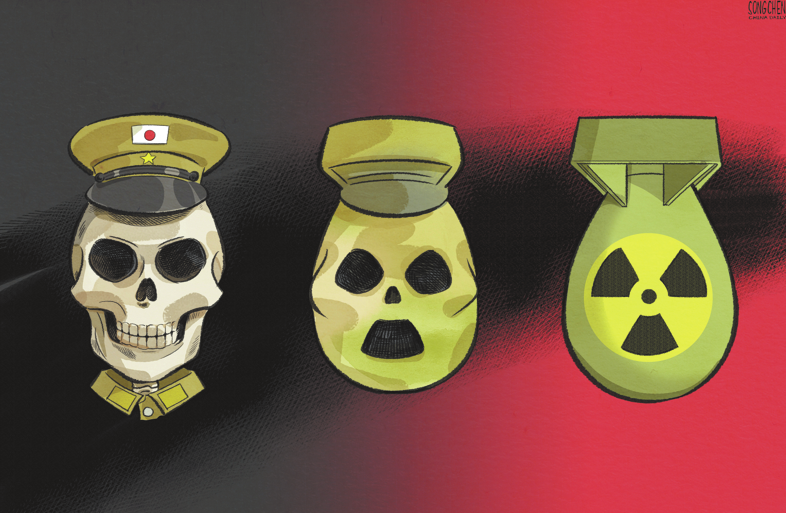
Recent reports that there was a radioactive water leak at the Fugen nuclear reactor in Tsuruga, Fukui Prefecture, Japan, which is undergoing decommissioning, have once again sounded an alarm about Japan's nuclear safety and risk management system.
Coming on the heels of Japan's controversial handling of the Fukushima Daiichi nuclear power plant disaster and its discharge of nuclear-contaminated water from the plant into the sea, the incident once again exposes serious deficiencies in the operation, maintenance and safety supervision of Japan's nuclear facilities, and reinforces the impression that Japan's nuclear security governance is inadequate.
As Chinese Foreign Ministry spokesperson Lin Jian noted, this is not an isolated case. Recent months have seen a number of safety incidents involving nuclear facilities in Japan, including the forgery of quality control of radiation detection devices at the Fukushima Daiichi nuclear power plant and the overflow of water from the spent fuel pool at the nuclear waste treatment plant in Rokushima Village, Aomori Prefecture, to name just two.
Rather than being technical mishaps, these incidents collectively point to systemic problems — dysfunctional facilities, chaotic management and ineffective supervision. Under such circumstances, Japan's assurances on nuclear safety understandably ring hollow to its neighbors and the broader international community.
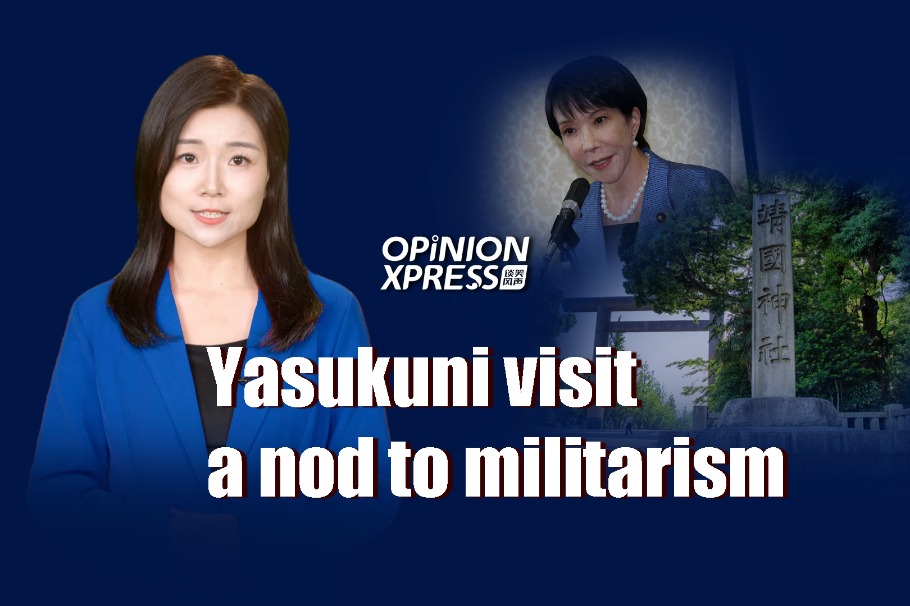
This reality makes the current trajectory of the Sanae Takaichi government all the more alarming. At a time when Japan's nuclear risk management record is under serious question, senior officials close to the prime minister have openly suggested that Japan should possess nuclear weapons, and the defense minister has refused to rule out revising the country's long-standing three nonnuclear principles.
There have also been worrying signals that Japan is considering introducing nuclear-powered submarines, reinforced by reports of Japanese defense officials boarding US nuclear submarines and Washington pushing Japan and the Republic of Korea toward such capabilities.
These moves have understandably put regional countries on high alert. That a country struggling to convincingly manage civilian nuclear risks and refusing to reflect on its past war crimes is being misled by a reckless right-wing government to pursue its remilitarization undoubtedly constitutes a security threat to the region and beyond. The danger is not abstract; it concerns people, the environment and regional stability.
Lin also rightly noted that calls for Japan to acquire nuclear weapons constitute a blatant challenge to the postwar international order and the nuclear nonproliferation regime. Japan's obligations under the Cairo Declaration, the Potsdam Proclamation, its own Constitution and the Treaty on the Non-Proliferation of Nuclear Weapons are clear and nonnegotiable. Attempting to blur or bargain over these commitments not only undermines international law, but also erodes the hard-won peace and stability of the Asia-Pacific.
The problem goes beyond nuclear policy. Takaichi's provocative and erroneous remarks on the Taiwan question, her interference in disputed territorial issues and historical revisionist tendencies have all met with strong opposition from China and other neighboring countries, including Russia. Together with pro-nuclear and pro-remilitarization statements, they expose a consistent pattern: the testing of red lines and the normalization of ideas that once brought disaster to the region.
It is no coincidence, as Lin observed, that such remarks have emerged alongside the Takaichi government's acceleration of the country's military buildup, featuring a rapid rise in defense spending, relaxed arms export restrictions and an expansion of the Self-Defense Forces' scope. These actions send an extremely dangerous signal. They challenge the postwar international arrangement and threaten regional peace, while doing nothing to address the security concerns of the Japanese people.
History has shown, at immense human cost, where Japan's unchecked militarism may lead. That is why the international community — especially the United States, which has deep influence over Japan's security posture — bears the responsibility to rein in these dangerous tendencies rather than encourage them. Turning a blind eye, or worse, offering tacit support, will only embolden forces that seek to overturn established norms.
Japan must learn the lessons of its wartime history and Fukushima alike. It should prioritize nuclear safety, transparency and international oversight, honor its legal commitments, and abandon ventures that push the region toward greater confrontation. China and all peace-loving countries will remain vigilant and firmly oppose its attempts to undermine the global nonproliferation regime.